
K8s Generic Server Graceful Shutdown#
假设服务器开启了所有可选开关,例如
ShutdownSendRetryAfter开关、AuditBackend开关等等都打开。官方给出的时序流程图位于:staging\src\k8s.io\apiserver\pkg\server\genericapiserver.go#L480-L521
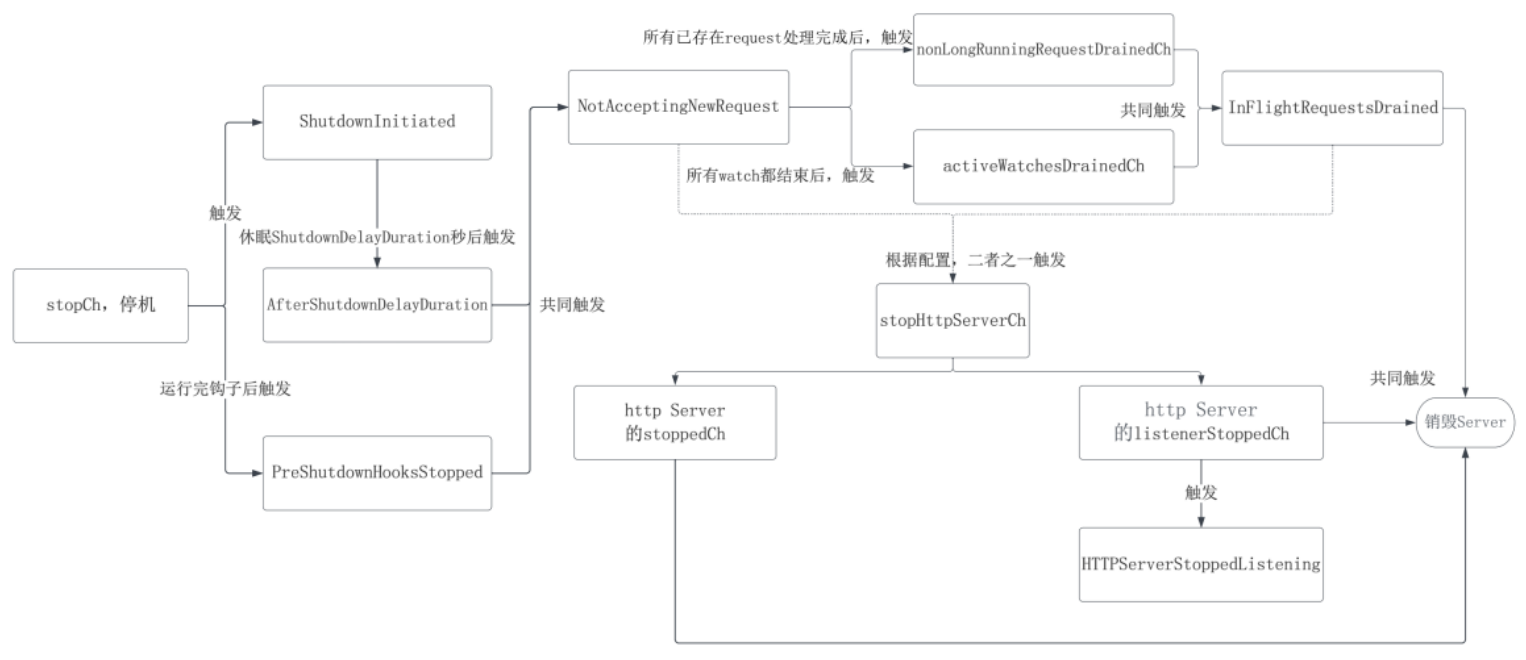
这里 Generic Server 的停机流程包括:
stopCh触发,ShutdownInitiated+ 延迟窗口。- PreShutdownHooks 完成 + 延迟结束 ⇒
NotAcceptingNewRequest⇒ 前门落下。 - 非长连接 + watch 分别排空 ⇒
InFlightRequestsDrained。 - 根据模式触发
stopHttpServerCh⇒ listener 停止 ⇒ net/http Shutdown 完成。 - Audit backend、HTTP server、Destroy 顺序收尾。
stopCh 触发#
// 代码: staging\src\k8s.io\apiserver\pkg\server\genericapiserver.go#L522-L525
func (s preparedGenericAPIServer) RunWithContext(ctx context.Context) error {
	stopCh := ctx.Done()
	delayedStopCh := s.lifecycleSignals.AfterShutdownDelayDuration
	shutdownInitiatedCh := s.lifecycleSignals.ShutdownInitiated
    ...
}RunWithContext把传入的 context 的Done()当作stopCh- 同时抓住两个声明周期信号:
AfterShutdownDelayDurationShutdownInitiated
	// 代码: staging\src\k8s.io\apiserver\pkg\server\genericapiserver.go#L555-L568
	go func() {
		defer delayedStopCh.Signal()
		defer klog.V(1).InfoS("[graceful-termination] shutdown event", "name", delayedStopCh.Name())

		<-stopCh

		// As soon as shutdown is initiated, /readyz should start returning failure.
		// This gives the load balancer a window defined by ShutdownDelayDuration to detect that /readyz is red
		// and stop sending traffic to this server.
		shutdownInitiatedCh.Signal()
		klog.V(1).InfoS("[graceful-termination] shutdown event", "name", shutdownInitiatedCh.Name())

		time.Sleep(s.ShutdownDelayDuration)
	}()
当 <-stopCh 时:
- 立即
shutdownInitiatedCh.Signal(),这会让/readyz变红,通知外部 LB 节点即将退出。//TODO - 随后
time.Sleep(ShutdownDelayDuration)才delayedStopCh.Signal()。这个“休眠窗口”就是给 LB 的摘除时间,避免停机瞬间仍有大量新请求涌入。
PreShutdownHooksStopped#
	// 代码: staging\src\k8s.io\apiserver\pkg\server\genericapiserver.go#L703-L716
	<-stopCh //要点①

	// run shutdown hooks directly. This includes deregistering from
	// the kubernetes endpoint in case of kube-apiserver.
	func() { //要点②
		defer func() {
			preShutdownHooksHasStoppedCh.Signal()
			klog.V(1).InfoS("[graceful-termination] pre-shutdown hooks completed", "name", preShutdownHooksHasStoppedCh.Name())
		}()
		err = s.RunPreShutdownHooks()
	}()
	if err != nil {
		return err
	}
主函数在要点①处被堵塞,当 <-stopCh 被触发之后,就会执行触发 RunPreShutdownHooks,等待其完成后 preShutdownHooksHasStoppedCh.Signal()
再来看看 preShutdownHooksHasStoppedCh.Signal() 会唤醒哪个部分:
	// 代码: staging\src\k8s.io\apiserver\pkg\server\genericapiserver.go#L622-L634
	preShutdownHooksHasStoppedCh := s.lifecycleSignals.PreShutdownHooksStopped
	go func() {
		defer klog.V(1).InfoS("[graceful-termination] shutdown event", "name", notAcceptingNewRequestCh.Name())
		defer notAcceptingNewRequestCh.Signal()

		// wait for the delayed stopCh before closing the handler chain
		<-delayedStopCh.Signaled()

		// Additionally wait for preshutdown hooks to also be finished, as some of them need
		// to send API calls to clean up after themselves (e.g. lease reconcilers removing
		// itself from the active servers).
		<-preShutdownHooksHasStoppedCh.Signaled()
	}()
可以看到,这里在等待 signCh 触发后的 delayedStopCh.Signal() 信号,和 RunPreShutdownHooks 完成后 preShutdownHooksHasStoppedCh.Signal() 信号。
当 delayedStopCh.Signal() 和 preShutdownHooksHasStoppedCh.Signal() 信号到达后,就会发送 notAcceptingNewRequestCh.Signal() 信号,进而进入下流程。
和流程图对比查看:
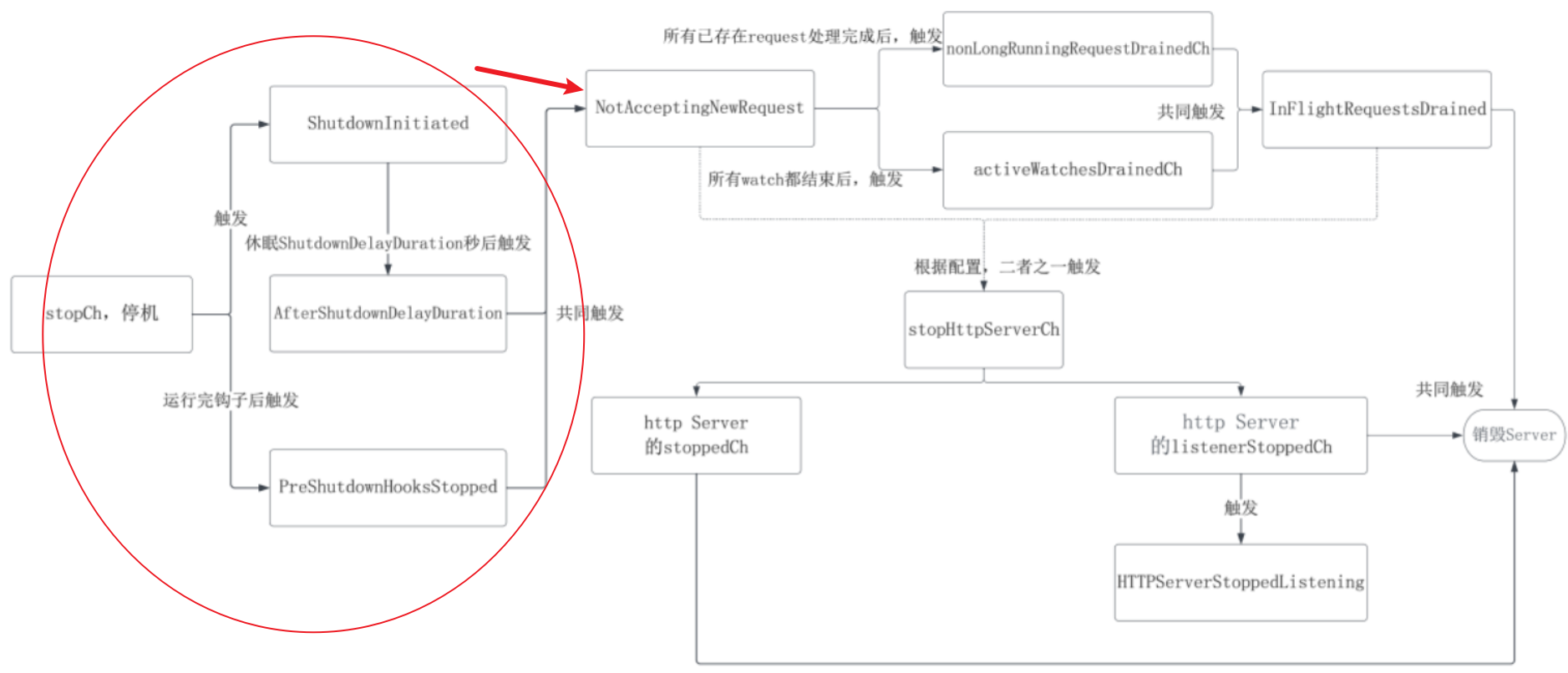
现在已经完成了左边的处理,进入到了 NotAcceptingNewRequest 流程。
流量控制【NotAcceptingNewRequest】#
这里的流量控制会根据 s.ShutdownSendRetryAfter 来进行配置,在 stopHttpServerCh 中,如果没有进行配置,那么在 stopHttpServer 中就会监听 NotAcceptingNewRequest,如果进行了配置,那么就会改为监听 InFlightRequestsDrained,代码如下:
	// 代码: staging\src\k8s.io\apiserver\pkg\server\genericapiserver.go#L583-L579
	notAcceptingNewRequestCh := s.lifecycleSignals.NotAcceptingNewRequest
	drainedCh := s.lifecycleSignals.InFlightRequestsDrained
	// Canceling the parent context does not immediately cancel the HTTP server.
	// We only inherit context values here and deal with cancellation ourselves.
	stopHTTPServerCtx, stopHTTPServer := context.WithCancelCause(context.WithoutCancel(ctx))
	go func() {
		defer stopHTTPServer(errors.New("time to stop HTTP server"))

		timeToStopHttpServerCh := notAcceptingNewRequestCh.Signaled()
		if s.ShutdownSendRetryAfter {
			timeToStopHttpServerCh = drainedCh.Signaled()
		}

		<-timeToStopHttpServerCh
	}()
首先监听
notAcceptingNewRequestCh;timeToStopHttpServerCh := notAcceptingNewRequestCh.Signaled()如果进行了配置:
if s.ShutdownSendRetryAfter {,那么则改为监听InFlightRequestsDrained:timeToStopHttpServerCh = drainedCh.Signaled()
非长连接排空#
	// 代码: staging\src\k8s.io\apiserver\pkg\server\genericapiserver.go#L636-L659
	// wait for all in-flight non-long running requests to finish
	nonLongRunningRequestDrainedCh := make(chan struct{})
	go func() {
		defer close(nonLongRunningRequestDrainedCh)
		defer klog.V(1).Info("[graceful-termination] in-flight non long-running request(s) have drained")

		// wait for the delayed stopCh before closing the handler chain (it rejects everything after Wait has been called).
		<-notAcceptingNewRequestCh.Signaled()

		// Wait for all requests to finish, which are bounded by the RequestTimeout variable.
		// once NonLongRunningRequestWaitGroup.Wait is invoked, the apiserver is
		// expected to reject any incoming request with a {503, Retry-After}
		// response via the WithWaitGroup filter. On the contrary, we observe
		// that incoming request(s) get a 'connection refused' error, this is
		// because, at this point, we have called 'Server.Shutdown' and
		// net/http server has stopped listening. This causes incoming
		// request to get a 'connection refused' error.
		// On the other hand, if 'ShutdownSendRetryAfter' is enabled incoming
		// requests will be rejected with a {429, Retry-After} since
		// 'Server.Shutdown' will be invoked only after in-flight requests
		// have been drained.
		// TODO: can we consolidate these two modes of graceful termination?
		s.NonLongRunningRequestWaitGroup.Wait()
	}()
当这里接收到了 <-notAcceptingNewRequestCh.Signaled(),则会 s.NonLongRunningRequestWaitGroup.Wait()
注意,这里的 Wait():
// staging\src\k8s.io\apimachinery\pkg\util\waitgroup\waitgroup.go
package waitgroup

import (
	"fmt"
	"sync"
)

// SafeWaitGroup must not be copied after first use.
type SafeWaitGroup struct {
	wg sync.WaitGroup
	mu sync.RWMutex
	// wait indicate whether Wait is called, if true,
	// then any Add with positive delta will return error.
	wait bool
}

// Add adds delta, which may be negative, similar to sync.WaitGroup.
// If Add with a positive delta happens after Wait, it will return error,
// which prevent unsafe Add.
func (wg *SafeWaitGroup) Add(delta int) error {
	wg.mu.RLock()
	defer wg.mu.RUnlock()
	if wg.wait && delta > 0 {
		return fmt.Errorf("add with positive delta after Wait is forbidden")
	}
	wg.wg.Add(delta)
	return nil
}

// Done decrements the WaitGroup counter.
func (wg *SafeWaitGroup) Done() {
	wg.wg.Done()
}

// Wait blocks until the WaitGroup counter is zero.
func (wg *SafeWaitGroup) Wait() {
	wg.mu.Lock()
	wg.wait = true
	wg.mu.Unlock()
	wg.wg.Wait()
}
这里的 SafeWaitGroup 的 Wait 会给 wg.wait 设置为 true,所以一旦 wg.Wait 之后,再每当新请求到来时,进行 wg.Add(1) 时,会引发 error。
这里讲解一下当新请求到来时,是如何走到 wg.Add(1)
新的请求已进入到 Generic Server,会按照 DefaultBuildHandlerChain 中定义的顺序通过一串 HTTP filter。
// 代码: staging\src\k8s.io\apiserver\pkg\server\config.go#L1014
func DefaultBuildHandlerChain(apiHandler http.Handler, c *Config) http.Handler {
	...
	handler = genericfilters.WithWaitGroup(handler, c.LongRunningFunc, c.NonLongRunningRequestWaitGroup) //#L1065
    ...
}
这里将 WithWaitGroup 被加入到 handler 链中,而 WithWaitGroup 的定义及实现如下:
// 代码: staging\src\k8s.io\apiserver\pkg\server\filters\waitgroup.go#L47-L88
// WithWaitGroup adds all non long-running requests to wait group, which is used for graceful shutdown.
func WithWaitGroup(handler http.Handler, longRunning apirequest.LongRunningRequestCheck, wg RequestWaitGroup) http.Handler {
	// NOTE: both WithWaitGroup and WithRetryAfter must use the same exact isRequestExemptFunc 'isRequestExemptFromRetryAfter,
	// otherwise SafeWaitGroup might wait indefinitely and will prevent the server from shutting down gracefully.
	return withWaitGroup(handler, longRunning, wg, isRequestExemptFromRetryAfter)
}

func withWaitGroup(handler http.Handler, longRunning apirequest.LongRunningRequestCheck, wg RequestWaitGroup, isRequestExemptFn isRequestExemptFunc) http.Handler {
	return http.HandlerFunc(func(w http.ResponseWriter, req *http.Request) {
		ctx := req.Context()
		requestInfo, ok := apirequest.RequestInfoFrom(ctx)
		if !ok {
			// if this happens, the handler chain isn't setup correctly because there is no request info
			responsewriters.InternalError(w, req, errors.New("no RequestInfo found in the context"))
			return
		}

		if longRunning(req, requestInfo) {
			handler.ServeHTTP(w, req)
			return
		}

		if err := wg.Add(1); err != nil {
			// shutdown delay duration has elapsed and SafeWaitGroup.Wait has been invoked,
			// this means 'WithRetryAfter' has started sending Retry-After response.
			// we are going to exempt the same set of requests that WithRetryAfter are
			// exempting from being rejected with a Retry-After response.
			if isRequestExemptFn(req) {
				handler.ServeHTTP(w, req)
				return
			}

			// When apiserver is shutting down, signal clients to retry
			// There is a good chance the client hit a different server, so a tight retry is good for client responsiveness.
			waitGroupWriteRetryAfterToResponse(w)
			return
		}

		defer wg.Done()
		handler.ServeHTTP(w, req)
	})
}
对于每个请求都会走到 if err := wg.Add(1); err != nil。
所以这里的逻辑就是,当『阀门』【<-notAcceptingNewRequestCh.Signaled() 】被关闭后,就会设置 s.NonLongRunningRequestWaitGroup.Wait(),然后再当每次新请求到来后,就会进入到 if err := wg.Add(1); err != nil 里的逻辑,即
- 先检查是否豁免:
isRequestExemptFn(req)与WithRetryAfter使用同一套判断,例如健康检查、认证探针之类的请求,即使停机也允许继续执行。若命中豁免,直接handler.ServeHTTP。 - 否则直接拒绝并告知重试:调用
waitGroupWriteRetryAfterToResponse写出Retry-After: 1头和{503 ServiceUnavailable}(当启用ShutdownSendRetryAfter时外层会改成 429),提示客户端“apiserver 正在停机,请快速重试到其他节点”。
因此,这里实现的就是“闸门已落后,非豁免新请求一律被挡,并收到明确的 Retry-After 信号”。
完成之后,就会发送:close(nonLongRunningRequestDrainedCh) 信号。
watch排空#
当 NotAcceptingNewRequest 的信号接收到后,还会进入到清空 Watch 的逻辑,代码如下:
	// 代码: staging\src\k8s.io\apiserver\pkg\server\genericapiserver.go#L661-#L692
	// wait for all in-flight watches to finish
	activeWatchesDrainedCh := make(chan struct{})
	go func() {
		defer close(activeWatchesDrainedCh)

		<-notAcceptingNewRequestCh.Signaled()
		if s.ShutdownWatchTerminationGracePeriod <= time.Duration(0) {
			klog.V(1).InfoS("[graceful-termination] not going to wait for active watch request(s) to drain")
			return
		}

		// Wait for all active watches to finish
		grace := s.ShutdownWatchTerminationGracePeriod
		activeBefore, activeAfter, err := s.WatchRequestWaitGroup.Wait(func(count int) (utilwaitgroup.RateLimiter, context.Context, context.CancelFunc) {
			qps := float64(count) / grace.Seconds()
			// TODO: we don't want the QPS (max requests drained per second) to
			//  get below a certain floor value, since we want the server to
			//  drain the active watch requests as soon as possible.
			//  For now, it's hard coded to 200, and it is subject to change
			//  based on the result from the scale testing.
			if qps < 200 {
				qps = 200
			}

			ctx, cancel := context.WithTimeout(context.Background(), grace)
			// We don't expect more than one token to be consumed
			// in a single Wait call, so setting burst to 1.
			return rate.NewLimiter(rate.Limit(qps), 1), ctx, cancel
		})
		klog.V(1).InfoS("[graceful-termination] active watch request(s) have drained",
			"duration", grace, "activeWatchesBefore", activeBefore, "activeWatchesAfter", activeAfter, "error", err)
	}()
这里的具体逻辑如下:
- 是否等待 watch:如果
ShutdownWatchTerminationGracePeriod <= 0,直接返回,不对 watch 做额外等待(保持旧行为)。 - 否则进入排空流程:
- 设
grace := ShutdownWatchTerminationGracePeriod,作为最长等待时间。 - 调用
s.WatchRequestWaitGroup.Wait并传入一个函数来配置节流器:- 根据当前活跃 watch 数量
count,计算需要的 QPS,让所有 watch 在grace内排空(qps = count / graceSeconds,但不低于 200,以确保 drain 足够快)。 - 创建
context.WithTimeout(grace),在超时后强制结束。 - 返回
rate.NewLimiter(突发 1)和上面的 context,用于控制同时结束 watch 的速率。
- 根据当前活跃 watch 数量
Wait返回前后活跃 watch 数量以及可能的 error,随后在日志中打印排空情况。
- 设
这里完成之后,就会发送 defer close(activeWatchesDrainedCh) 。
InFlightRequestsDrained#
在主函数中,会启动一个协程来监听流量控制里的两个请求:
	// 代码: staging\src\k8s.io\apiserver\pkg\server\genericapiserver.go#L694-700
	go func() {
		defer klog.V(1).InfoS("[graceful-termination] shutdown event", "name", drainedCh.Name())
		defer drainedCh.Signal()

		<-nonLongRunningRequestDrainedCh
		<-activeWatchesDrainedCh
	}()
在这里接收到了两个信号后,就会发送 defer drainedCh.Signal(),正好,这个请求,也就是在设置了 s.ShutdownSendRetryAfter 之后,stopHttpServerCh 监听的信号。
Audit 收尾#
只有在所有请求排空后才关掉审计后端,防止日志丢失。这里没有在流程图中进行展示,见如下代码:
	// 代码: staging\src\k8s.io\apiserver\pkg\server\genericapiserver.go#L719-L724
	// Wait for all requests in flight to drain, bounded by the RequestTimeout variable.
	<-drainedCh.Signaled()

	if s.AuditBackend != nil {
		s.AuditBackend.Shutdown()
		klog.V(1).InfoS("[graceful-termination] audit backend shutdown completed")
}通过上面的学习,我们知道,<-drainedCh.Signaled() 到来的时候,就会排空所有请求,这里就会通过 s.AuditBackend.Shutdown() 来关闭掉审计后端。
HTTP Server 停止#
	// 代码: staging\src\k8s.io\apiserver\pkg\server\genericapiserver.go#L583-L579
	notAcceptingNewRequestCh := s.lifecycleSignals.NotAcceptingNewRequest
	drainedCh := s.lifecycleSignals.InFlightRequestsDrained
	// Canceling the parent context does not immediately cancel the HTTP server.
	// We only inherit context values here and deal with cancellation ourselves.
	stopHTTPServerCtx, stopHTTPServer := context.WithCancelCause(context.WithoutCancel(ctx))
	go func() {
		defer stopHTTPServer(errors.New("time to stop HTTP server"))

		timeToStopHttpServerCh := notAcceptingNewRequestCh.Signaled()
		if s.ShutdownSendRetryAfter {
			timeToStopHttpServerCh = drainedCh.Signaled()
		}

		<-timeToStopHttpServerCh
	}()
这里在收到 <-timeToStopHttpServerCh 后,会开始执行 stopHTTPServer(errors.New("time to stop HTTP server")) 函数。
这里关闭 HTTP Server 的逻辑是这样的:
在
RunWithContext中,用context.WithCancelCause(context.WithoutCancel(ctx))生成stopHTTPServerCtx与stopHTTPServer,然后把该 ctx 传给NonBlockingRunWithContext去启动 secure HTTP server,代码如下:// 代码: staging\src\k8s.io\apiserver\pkg\server\genericapiserver.go#L608 stoppedCh, listenerStoppedCh, err := s.NonBlockingRunWithContext(stopHTTPServerCtx, shutdownTimeout)然后在
NonBlockingRunWithContext内部创建internalStopCh【要点①】,并启动 goroutine 等待stopHTTPServerCtx.Done(),一旦 Done,就close(internalStopCh)【要点②】,代码如下:// 代码: staging\src\k8s.io\apiserver\pkg\server\genericapiserver.go#L748-L777 // NonBlockingRunWithContext spawns the secure http server. An error is // returned if the secure port cannot be listened on. // The returned channel is closed when the (asynchronous) termination is finished. func (s preparedGenericAPIServer) NonBlockingRunWithContext(ctx context.Context, shutdownTimeout time.Duration) (<-chan struct{}, <-chan struct{}, error) { // Use an internal stop channel to allow cleanup of the listeners on error. internalStopCh := make(chan struct{}) // 要点① var stoppedCh <-chan struct{} var listenerStoppedCh <-chan struct{} if s.SecureServingInfo != nil && s.Handler != nil { var err error stoppedCh, listenerStoppedCh, err = s.SecureServingInfo.Serve(s.Handler, shutdownTimeout, internalStopCh) if err != nil { close(internalStopCh) return nil, nil, err } } // Now that listener have bound successfully, it is the // responsibility of the caller to close the provided channel to // ensure cleanup. go func() { // 要点② <-ctx.Done() close(internalStopCh) }() s.RunPostStartHooks(ctx) if _, err := systemd.SdNotify(true, "READY=1\n"); err != nil { klog.Errorf("Unable to send systemd daemon successful start message: %v\n", err) } return stoppedCh, listenerStoppedCh, nil }在调用
s.SecureServingInfo.Serve,也将internalStopCh进行传入,最终将internalStopCh传入RunServer,// 代码: staging\src\k8s.io\apiserver\pkg\server\secure_serving.go#L215-L266 // RunServer spawns a go-routine continuously serving until the stopCh is // closed. // It returns a stoppedCh that is closed when all non-hijacked active requests // have been processed. // This function does not block // TODO: make private when insecure serving is gone from the kube-apiserver func RunServer( server *http.Server, ln net.Listener, shutDownTimeout time.Duration, stopCh <-chan struct{}, ) (<-chan struct{}, <-chan struct{}, error) { if ln == nil { return nil, nil, fmt.Errorf("listener must not be nil") } // Shutdown server gracefully. serverShutdownCh, listenerStoppedCh := make(chan struct{}), make(chan struct{}) go func() { defer close(serverShutdownCh) <-stopCh ctx, cancel := context.WithTimeout(context.Background(), shutDownTimeout) defer cancel() err := server.Shutdown(ctx) if err != nil { klog.Errorf("Failed to shutdown server: %v", err) } }() go func() { defer utilruntime.HandleCrash() defer close(listenerStoppedCh) var listener net.Listener listener = tcpKeepAliveListener{ln} if server.TLSConfig != nil { listener = tls.NewListener(listener, server.TLSConfig) } err := server.Serve(listener) msg := fmt.Sprintf("Stopped listening on %s", ln.Addr().String()) select { case <-stopCh: klog.Info(msg) default: panic(fmt.Sprintf("%s due to error: %v", msg, err)) } }() return serverShutdownCh, listenerStoppedCh, nil }这里有两个协程,
- 第一个协程是优雅关闭
http server,很好理解; - 第二个协程是关闭
listener,这里的一般会阻塞在err := server.Serve(listener),一旦stopCh关闭,server.Shutdown会打断Serve,后续的Select是用来进行判断是否正常退出,如果是stopCh到来,导致进入 Select,即正常退出,如果stopCh没有到来,则会进入到default中,从而 Panic。
- 第一个协程是优雅关闭
收尾工作#
在 RunWithContext 的开头,有一句 defer 语句,用来进行最后的资源释放:
// 代码: staging\src\k8s.io\apiserver\pkg\server\genericapiserver.go#L522
func (s preparedGenericAPIServer) RunWithContext(ctx context.Context) error {
	...
	// Clean up resources on shutdown.
	defer s.Destroy() //#L528
    ...
}
支持,Generic Server 的关停流程就详细讲解关闭,我们也对 RunWithContext 有了足够的了解。